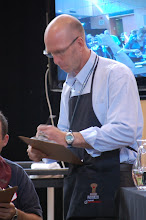
I am ambivalent about the positive and negative aspects of manual brewing other than it's value as a profit centre which meets a consumer demand. I am concerned that many of those who advocate manual brewing are supplying a product in the hope customers buy, instead of producing a product the customers demand. That being said, I want to examine the unique costing that applies to manual brewing so that coffee shop owners might determine whether it is right for them.
For this costing, I will use a tool that many of you are using, the excellent Intelligentsia app for iphone, and focus on the pour over method.
For this we need:
28g of whole bean coffee which I will assume $10/lb wholesale cost
V60 Dripper
V60 filter Cost $0.065
Hario Kettle or Similar
Burr Grinder
Digital Scale
Vessel to brew into
While the prescribed brew time is 2.5 minutes, I am assuming a total prep and brew time of 7.5 mins. Prep time includes water boil, coffee weighing and grinding, filter pre wash, and brew.
The costing looks something like this:
Bean Cost
454g/28g =16.21
$10 (bean cost)/ 16.21 = $0.62
Filter Cost
= $0.065
Labour Cost (Using my local minimum wage for barista's $10.25)
$10.25 x 1.15(payroll tax) = $11.78
7.5 mins/ 60mins = .125
$11.78 x .125 = $1.47
Cup and Lid (if needed)
$0.25
Cost of Goods Sold (COGS)
$0.62 + $0.065 + $0.25 = $0.935
Total Cost
0.62 + 0.065 + 1.47 + 0.25 = $2.405
I am going to try to work out a retail price using a couple of different methods.
First Method:
I have stated a couple of times in this blog that an excellent target for labour is 20-30% of revenue. I am going to ignore the fact that while one person is preparing the pour over, that revenue also needs to partially cover the cost of the labour required to take the order and only focus on the single barista. If I use the 20-30% guideline, then the retail cost should be between $1.47 X 3.33= $4.90 and $1.47 x 5 = $7.35
If we back out cost we can figure out the contribution each pour over makes to General and Administration by doing the following:
$4.90 - 2.405 = $2.495
$7.35 - 2.405 = $4.945
Second Method:
If we use a typical gross profit margin of .70 to calculate a retail price
$0.935 / 30 x 100 = $3.11
If we subtract labour cost from this number we get,
$3.11 - $1.47 = $0.707
From this calculation $0.707 represents the contribution each pour over would make to G&A costs and hopefully some profit.
Third Method:
Using a guideline for labour productivity and revenue per employee hour of $50, and the fact that a barista can do 8 pour overs per hour at 7.5mins per pour, we can calculate how much money we need to charge to hit the target.
$50 / 8 = $6.25
Contribution G&A = $6.25 - $2.405 = $3.845
While I don't profess to know all of the variables present in anyone else's coffee shop, I definitely think that these figures represent an excellent guideline for pricing your pour over. Remember that my labour calculation does not include labour required to take the order, or any management/back office labour. Given the increased labour cost associated with manual brewing, calculating based on gross margin is likely a mistake. Conversely, because labour is so high, applying high labour ratios to manual brewing likely prices it beyond any demand curve. A calculation based on overall labour productivity seems to yield more predictable pricing, and permits increased profit or more approachable pricing by increasing the efficiency of the barista.
In general, I think it's safe to conclude that if you are pricing your pour over coffee under the $4.00 mark, you should take a very hard look at your numbers.
I am including a quote from a recent article in Esquire Magazine by Todd Carmichael "375 cents (n) — An insane amount to pay for any single cup of coffee, unless of course one is at the foot of the Spanish Steps and in the company of a potential sexual partner above one's standing. If in Brooklyn, however, see also: Nigeria scam; bridge for sale."
While I acknowledge the article causes a great deal of negative reactions from those prone to comment, it is none the less valid and typical of most coffee consuming public. The problem is, price your pour over under $4 and you risk losing money, price it higher and you risk offending customers.
Try using some of the methods I've suggested and plug in your own numbers to determine whether pour overs are contributing to your profitability or even covering costs.
Showing posts with label Break Even Analysis. Show all posts
Showing posts with label Break Even Analysis. Show all posts
Wednesday, January 26, 2011


Monday, January 3, 2011
Break Even Analysis
Break Even Analysis is in my opinion the most important number in running any coffee business...how much do I have to sell to pay all of the bills? Normally we would determine break even for a specific period of time, usually per month. A simple definition applied to a coffee shop is how many customers, when multiplied times the average gross margin sale amount is equal to the cost of doing business. (Refer to Income Statement Page for review of Gross Margin)
From our Income Statement Sample Page our gross margin is $0.637 per dollar, and it cost us $334,180 in Labour, and GSA to run our business, we need to sell 334,180/0.637 worth of sales, or $524,615.38 to hit our break even point.
Let's say we know that on average, each transaction at our cafe is for $5.85, we can now determine that we need $524,615.38/5.85= 89677.84 customers per year, or approximately 250 customers per day.
These are all very simple calculations, using numbers generated by either our cash register, or our income statements, that can quickly identify whether our coffee shop is able to pay it's bills. If there exists a situation whereby we can't get enough people through the door, we need to address either gross margin, pricing, or average per sale figure. But first we need our break even. Spend some time familiarizing yourself with this concept, and let me know if this info is useful to you.
Subscribe to:
Posts (Atom)

 Posts